
Pistol rounds: count, cash and conditional cascades
A pistol win changes the score and the next purchase state. It does not reveal a universal map-win uplift. This guide uses invented probabilities to show how an opening advantage can propagate, where conditional denominators matter and what evidence a live forecast would need. The previous 78.4% and 58.2% figures are retained only as hypothetical inputs below. No tournament dataset is supplied that establishes them as professional conversion rates. A model should keep the map, side, lineup, game version and information timestamp attached to every estimate. Combining incompatible rounds into one percentage can disguise precisely the economy differences being studied.
What the opening round actually changes
In a specified MR12 regulation format, the first team to thirteen rounds wins, with a side switch after twelve. Round one and round thirteen are the two regulation pistol rounds. Winning both contributes two actual rounds: 2/13 = 15.384615% of the winning target. That fraction is a count, not a probability of winning the map, a lower bound on that probability or a guaranteed change in it. A team can win both pistols and still lose the map. The second pistol is also future information until it has actually happened. A forecast made before round thirteen cannot condition on knowing its winner.
Build a conditional tree
Suppose that, conditional on winning the opening pistol, the chance of also winning round two is 0.784 and the chance of winning both rounds two and three is 0.582. These are different events. Dividing the latter by the former gives the chance of round three conditional on the two-round lead. The denominator includes only paths with a round-two win. It does not estimate the chance of round three after a round-two loss. The full expectation needs that missing branch, represented below by x. Without x, 2.366 is a lower bound on expected wins in the first three rounds, conditional on the pistol result; it is not an observed average.
Squaring 0.582 gives the chance of two complete cascades only if the two half paths are assumed independent after conditioning on both pistol wins and the chosen other information. That independence is an extra modeling decision. Team quality, side preference, changing tactics and roster information can couple the halves. Six rounds collected across those paths remain six score units, not 46.15% map-win probability. Also distinguish a cumulative three-round lead from a third-round marginal win: the first requires winning both intervening rounds; the second can occur after either outcome in round two. Report the event in words before presenting its percentage.
Hypothetical inputs, conditional on a pistol win:
a=P(R2 win)=0.784; b=P(R2 and R3 wins)=0.582
P(R3 win | R2 win)=b/a=0.742346939
x=P(R3 win | R2 loss), 0<=x<=1
E[first 3 wins]=1+a+b+(1-a)*x=2.366+0.216*x
Two full cascades: b*b=0.338724 ONLY if conditional independence
2/13=15.384615% of target count; 6/13=46.153846% of target count
800-650+1900=2050; 2050+2400=4450
2050-1350+2400=3100; 4*(600-300)=1200 additional reward
Track money without inventing a loadout
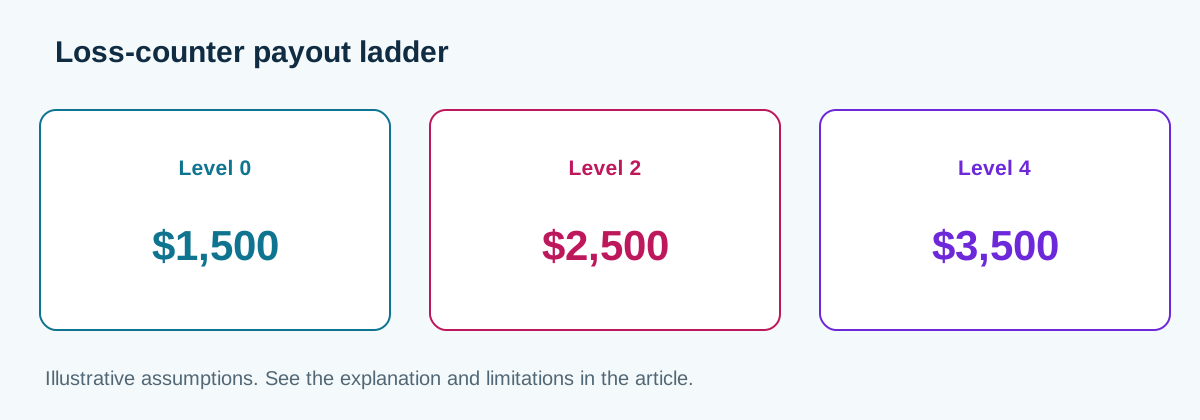
For an illustrative cash path, assume 800 initial cash, spending 650, then an eligible opening-loss payout of 1900. With no other income or deductions, the next balance is 2050. Saving all of it and losing again for 2400 produces 4450. Spending 1350 instead leaves 700, and the same next loss produces 3100. These arithmetic branches do not establish which equipment five players can buy. Retained weapons, transfers, individual balances, plant income, kill rewards, caps and payout eligibility all need separate inputs. Verify the event configuration rather than carrying the same initial state into every half or overtime.
Do not convert a hypothetical reward comparison into a tactical guarantee. If one chosen weapon pays 600 per kill and another pays 300, four qualifying kills produce an additional 4×(600−300)=1200, not an additional 2400. The 2400 is the first weapon's total reward. The comparison assumes the same four kills under both choices, which itself need not be realistic. Range, armor, utility, positioning and survival change the path. A larger conditional reward does not prove a higher round-win rate. Use current verified equipment data for a real match; the example is arithmetic rather than a weapon-price table.
Separate a quoted price from a probability
Consider invented quotes of 1.65 before a pistol and 1.25 afterward. Their reciprocals change from 60.606061% to 80%, a difference of 19.393939 percentage points. Those are raw implied probabilities from separate times, with potentially different information and margins. The difference does not prove overreaction. Even normalizing a complete two-sided market only produces a chosen market reference. It does not measure the true probability. No fixed eight-to-eleven-point correction follows from the score alone. A defensible assessment needs a forecast formed using information available at that moment, a comparable offered market and an executable accepted price.
At an invented underdog quote of 3.90, assuming win probability 0.30 gives EV = 0.30×3.90−1 = +17% per unit staked. Assuming 0.24 at that same quote instead gives −6.4%. The break-even probability is 1/3.90 = 25.641026%. The positive example therefore demonstrates sensitivity to an assumption, not a discovered opportunity. With the first assumption, full Kelly is 0.17/2.90 = 5.862069% and quarter Kelly is 1.465517%. Fractions reduce exposure but do not repair an incorrect probability. Correlated positions, uncertain inputs and an unavailable quote invalidate treating that isolated number as an automatic stake recommendation.
Totals require the whole score path
For regulation first-to-thirteen scoring, Under 21.5 requires a finish of 13–8 or wider. A 13–9 finish totals twenty-two. At an 8–4 halftime score, a future 13–8 finish allows the trailing team four additional rounds; its fifth additional round would push the eventual regulation total to at least twenty-two if the leader wins 13–9. A second pistol win alone settles neither path. At a 12–12 tie, twenty-four rounds have already been played, so Under 21.5 cannot win if those rounds count for that market. Always read whether the market includes overtime, how interrupted maps settle and whether its displayed total is full-map or remaining-rounds only.
A handicap and a total may depend on the same future rounds. Their joint probability is not the product of marginal probabilities unless independence is justified. Avoid using the second pistol outcome to backtest a bet supposedly placed at halftime: that leaks future information into selection. Save the halftime inputs and evaluate every selected map, including the maps with the unfavorable pistol result. Likewise, an opening loss does not prove a later comeback price is valuable. Cash recovery has no universal fourth-round deadline. A team may spend, save weapons, lose income eligibility or choose a different purchase. Update the actual state rather than extending a narrative about momentum.
A reviewable match record
A useful record includes event rules, map and side, score, cash by player, equipment, payout level, source time, observed delay, the exact betting market, requested and accepted prices, accepted stake, forecast and reasons for passing. Record probabilities before results. Separate the cash model's error from its conversion model's error: correctly predicting a balance does not validate a win rate. Keep training and evaluation periods separate and report which matches were missing. Small subgroup counts deserve uncertainty rather than a precise universal percentage. Closing-price comparison can help diagnose pricing differences, but a favorable comparison is not proof of positive expected profit.
Before using a result, ask whether it is an observed state, a game-rule input, a fitted estimate or an illustrative assumption. Each has a different validation route. Reproduce money arithmetic from the recorded purchases; estimate conversion with a defined eligible denominator; test the forecast on later comparable rounds; compare the exact event with the accepted quote. If any link is missing, leave the conclusion conditional. The framework explains a possible cascade without promising a profitable freeze-time window. Related models below provide further calculations, not independent certification of the inputs or of any operator's speed.