Mistake #5: Inferring Cash and Round Results from the Score Alone
A team wins two rounds and then loses. That sequence does not uniquely determine its loss payout or next purchase. You need the starting loss counter, remaining cash, equipment and the round outcome. A pistol win also does not guarantee the next two rounds. Treat those as separate state and probability questions.
The examples below use the simulator's explicit loss-counter convention and assumed spending. They are not observations from 2,400 professional maps and do not establish a 28–34% force-buy conversion rate. Check the event's configuration and current inventory before applying a model to an actual game.
A loss level is not simply consecutive losses
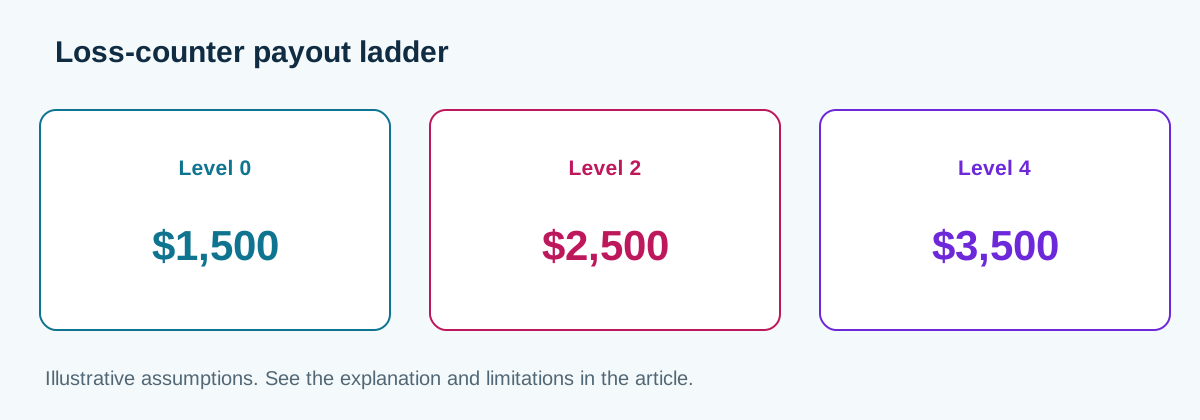
Valve's 2019 loss-counter change replaced the automatic reset after a win with a reduction by one. In the convention used here, the current level L selects the payout for a loss; only afterward does a loss increase the level, capped at 4. A win reduces it by one, floored at 0. Read the state before updating it.
- L=0: loss payout $1,400.
- L=1: loss payout $1,900.
- L=2: loss payout $2,400.
- L=3: loss payout $2,900.
- L=4: loss payout $3,400.
Starting at L=4, two wins leave L=2. The next loss pays $2,400 and then advances the level to 3. Starting at L=2, two wins instead leave L=0 and the next loss pays $1,400. The same win-win-loss sequence therefore has different payouts. Describing it as a universal reset loses the starting-state information.
Cash is a separate variable. A loss payout is not the team's entire next balance. Add unspent cash and applicable income; account for equipment already held and the actual rules. Different players can have different inventories and kill rewards. A per-player average is an approximation, not a literal five-player loadout.
Reproduce cash branches before assigning a win probability
For the following cash-only examples, spending is fixed, kill rewards and saved equipment are excluded, and balances remain below the cap. The amount spent is an assumed model parameter, not a claim about the current price of every item in a full buy.
CT: cash 4800, spend 4700, L=1, lose
Next cash = 4800 - 4700 + 1900 = 2000
T: cash 2300, spend 2200, L=2, lose without plant
Next cash = 2300 - 2200 + 2400 = 2500
T: same assumed loss, plant bonus 800
Next cash = 2500 + 800 = 3300
The CS2 economy simulator demonstrates these branches with its assumptions displayed. Its map percentages and buy-tier matchup matrix are not a dated calibration dataset. A valid income calculation does not validate the displayed round-win probability.
A second example illustrates why “double eco” is conditional. Suppose a player has $1,400, a modeled purchase target is $5,000 and the next losing-round payout is $1,900. With no spending or other income, another loss leaves $3,300. A further loss at the next level adds $2,400, leaving $5,700. That scenario describes the specified losing path. It neither forces the player to choose a full save nor determines the winner of either round.
Opening rounds and half changes need their own starting state
Under the simulator's regulation-half initial state, the loss level starts at 1. Two opening wins reduce it to 0; a later loss then uses the $1,400 payout. A T-side pistol loss at level 1 with the modeled plant bonus gives $1,900+2,700 before other cash adjustments. This is not the same starting state as a mid-half level-4 example.
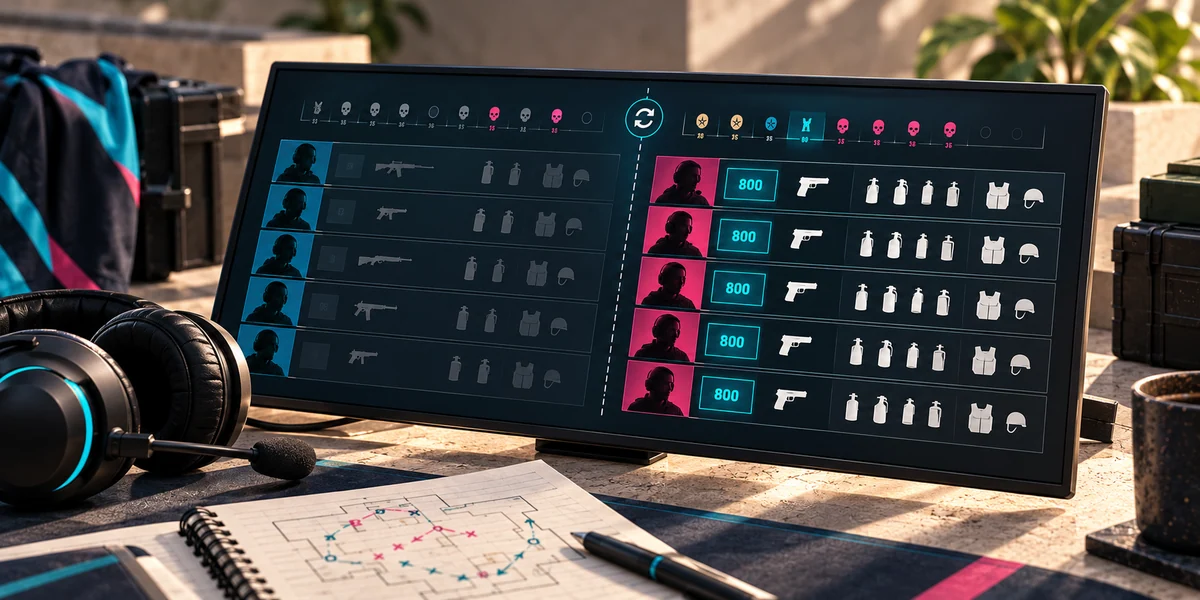
A side change is also not simply the continuation of the last round's cash. Apply the event's half-reset settings before projecting the next pistol round. The model uses a new $800 starting balance and loss level 1. You cannot infer an empty second-half treasury from a team spending its cash to win round 12. Overtime settings may differ again.
The MR12 economy guide and pistol-round discussion provide related questions to inspect. Their examples do not replace observing the inventory and applicable settings. Confirm what is known instead of inserting an imagined standard buy.
A possible force-buy is not a measured betting edge
No measured conversion-rate dataset is supplied here. To estimate one, define patch, event tier, side, plant state, spending and outcome; preserve the raw rounds and evaluate on later matches. Averaging unlike situations cannot by itself establish the next matchup probability.
| Hypothetical win probability | Quote | EV = p × odds − 1 |
|---|---|---|
| 20% | 3.20 | −36% |
| 30% | 3.20 | −4% |
| 40% | 3.20 | +28% |
The same quote has different expected returns under different assumed probabilities. Break-even at 3.20 is 31.25%. A bomb plant or a visible rifle does not prove that threshold has been crossed. Do not turn a plausible upset path into an automatic instruction to back the underdog.
Keep economic state separate from total-round bounds
At a score of 7-6, 13 rounds are complete. In a first-to-13 regulation model, six more wins by the leader would finish 13-6 after 19 rounds. That is one possible score path, not a ceiling or probability prediction. Other paths reach more rounds or overtime. Low cash cannot make a particular Under bet certain.
Record each side's actual counter, cash, equipment, assumed purchase and information timestamp. Then state the probability model and compare the accepted quote for the exact market. Use the side-asymmetry guide for related modeling inputs. Preserve uncertainty about both the purchase decision and the round result.
A ledger for checking the model
A useful test record contains the map and half, round number, side, loss level before the round, cash before spending, assumed spending, other included income, result and next cash. Keep observed values separate from modeled ones. An unknown inventory must remain unknown rather than being silently replaced with a full buy. Write the source time as well: a balance from before the previous round and a quote from after it do not describe one decision state.
Consider another hypothetical cash-only branch. A player starts with 3,300, loss level 3, and spends 1,000. Assume a loss, no other income and no cap effect. The next balance is 3,300 - 1,000 + 2,900 = 5,200 and the next loss level is 4. With zero spending on that same specified losing path, the next balance would be 6,200. These are alternative actions, not two simultaneously observed balances. The arithmetic does not estimate which action the player will choose or the probability of losing.
For a five-player team, store individual cash when available. The invented vector [0, 0, 0, 0, 10000] averages 2,000 per player, as does [2000, 2000, 2000, 2000, 2000]. They are not identical purchase states. Existing equipment, roles and possible weapon transfers matter. An average-only simulator deliberately compresses that information. Do not interpret its tier label as a verified equipment list or infer five identical purchases from one average balance.
After the round, first compare the observed balance with the conditional cash forecast. A discrepancy can come from spending, excluded rewards, retained cash, different settings or an incorrectly recorded counter. Resolve that state mismatch before changing a probability coefficient. A wrong cash input and a badly calibrated round model are different problems. Even a correctly predicted cash balance supplies only one validation check; it does not prove the forecast of the next round's winner.
When checking probabilities over many rounds, keep the prediction made before the outcome and define the sample rule in advance. Include ordinary losses as well as memorable upsets, and do not classify a buy using weapons that only became visible afterward if that information was unavailable at the decision time. Separate patches and event settings where they change the interpretation. Report uncertainty instead of turning a handful of surprising wins into a universal conversion rate or a promised betting return.