
Mistake #2: Treating a Video Stream as the Current Game State
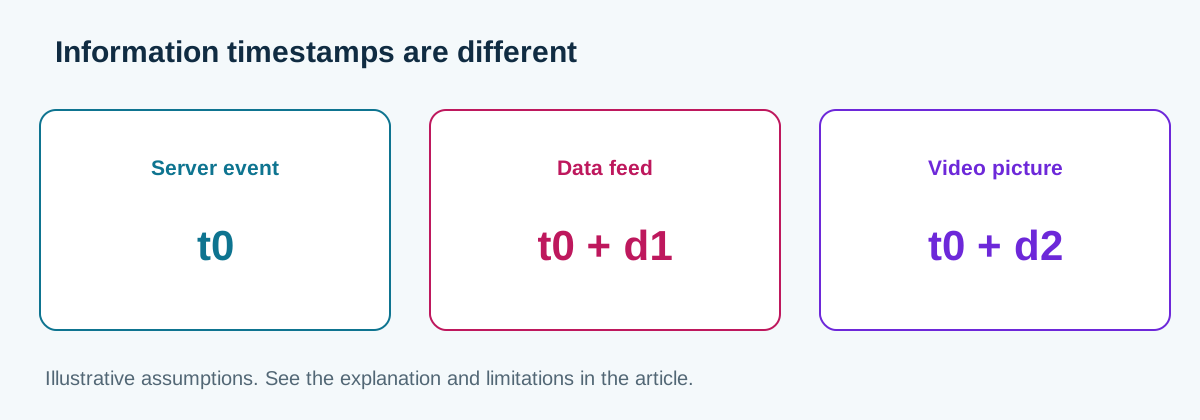
The live badge on a broadcast does not mean the displayed action is simultaneous with the game server or the bookmaker's information. A video can show an earlier round while the line reflects a later state. If your forecast uses the picture and your price belongs to another moment, a correct tactical observation can still produce the wrong decision. Before calculating value, establish which event and time each source describes.
There is no single measured delay for all esports broadcasts. Production choices, tournament settings, streaming mode, player buffering, connection quality and rewinding all matter. This article does not contain end-to-end measurements of GRID, Bayes, Twitch, YouTube or any bookmaker. It cannot rank operators by speed or tell you that a provider always beats the video by a specific number of milliseconds.
A pause does not synchronize the sources. When you see a timeout begin, the actual timeout may already have ended. A frozen game clock on screen is not proof that the server is currently frozen or that the displayed quote will be accepted.
1. Know what the platform's latency describes
YouTube's latency documentation distinguishes normal, low and ultra-low modes. It describes most viewers of ultra-low streams as experiencing less than five seconds of platform latency, with increased buffering risk. This is not a promise about the full path from an esports server through production to your screen. An intentional delay before the platform receives video can add time outside that description. The documentation is evidence against treating 30–90 seconds as a universal constant.
The broadcast path and the bookmaker's information path are separate. Video may pass through an observer, production, encoding, distribution and playback. A data service may deliver events through another route. The article does not establish the commercial contracts, event coverage or delivery protocol of an individual sportsbook. Neither the phrase official data nor a WebSocket connection proves a particular event-to-price latency, a correct probability estimate or guaranteed arbitrage.
A faster secondary scoreboard can be a useful warning that your video is behind. It is not automatically a reliable server clock: it can have its own update interval, cached state or event mismatch. Compare a clearly identified occurrence, such as the same completed round, rather than subtracting two unrelated displayed numbers. The broader stream-delay guide concerns this timing problem; its examples should also be read with their stated assumptions.
2. Label illustrative timestamps honestly
The following timeline is constructed to show subtraction. It is not a captured network trace, a latency benchmark or a description of a particular provider. All timestamps use the same hypothetical clock. In a real measurement, clocks and event identities would need to be aligned before interpreting the differences. A displayed player statistic alone cannot supply the missing server reference.
Hypothetical timeline, seconds after one event:
Event occurs:                 t = 0.0
Bookmaker receives event:     t = 0.4
Viewer sees video event:      t = 42.0
Viewer submits request:       t = 43.5

Video vs bookmaker receipt:  42.0 - 0.4 = 41.6 s
Request vs bookmaker receipt:43.5 - 0.4 = 43.1 s
Neither difference is a measured provider latency.
In this example the bookmaker has the event before the viewer acts. That does not mean it knows the eventual match result. Some markets may already be suspended or repriced; others concern uncertain future play. Check the exact selection and current quote rather than describing every accepted ticket as a bet on a result that has already happened. A stale observation creates an information risk, not an automatic proof that every possible live bet is negative EV.
3. Submission is different from acceptance
A spinner can reflect network transport, processing, a deliberate acceptance delay or another check. Without documentation or logs, its duration does not reveal the internal decision rule. As one explicit operator example, section 10.1 of Stake's terms makes confirmation the condition of acceptance. Read the applicable terms for your actual service; do not assume every operator uses the same timer or policy.
Keep the requested price, submission time, final response, accepted price and status separate. A rejected request is not a settled losing bet. A confirmed wager later voided under the rules is another event again. If a price changes, do not assume your original calculation still applies. A confirmation should be inspected before submitting a duplicate request or treating the intended amount as an existing position.
Adverse selection is a possible risk when accepted requests differ systematically from rejected ones. Demonstrating it requires a record of all requests, including rejections and price changes, not just losing tickets. This guide has no evidence that operators always reject favorable changes and accept unfavorable ones. It also has no sample proving that 200 live wagers must exhaust a bankroll. Those claims cannot be inferred from an animation on the screen.
4. Recalculate when information changes
Suppose a model assigns a hypothetical win probability of 0.55 to a selection at decimal odds 1.90. EV per unit is 0.55 × 1.90 - 1 = +4.5%. If later information changes the estimate to 0.48 while the offered price remains 1.90, EV becomes -8.8%. If the probability stays at 0.55 but the accepted price falls to 1.75, EV becomes -3.75%. These are sensitivity examples, not a measured link between a kill and match probability.
On a narrow screen, scroll the table sideways to see every column.
| Hypothetical state | Probability | Odds | EV |
|---|---|---|---|
| Original estimate | 55% | 1.90 | +4.5% |
| Changed information | 48% | 1.90 | -8.8% |
| Changed price | 55% | 1.75 | -3.75% |
A timeout can provide time to inspect assumptions, but it removes neither existing video delay nor uncertainty about when play resumes. Team decisions, price changes and acceptance processing can continue while the game clock is stopped. Between maps, verify the actual completed score, next map and lineup. No interval is presented here as a guaranteed profitable window or a way to obtain CLV without execution risk.
Our CS2 economy simulator can explore specified cash states under its simplified assumptions. A loss does not by itself force two lost rounds or prove the bookmaker misprices the recovery. Likewise, the radar and video comparison does not establish that a named operator has a slower line. Different quotes can reflect timing, margin, rules or uncertainty, rather than available profit.
5. A record you can inspect later
- Identify the event, map, market and settlement rules. Do not compare different round or map selections.
- Record the source, displayed score and clock, local observation time, and any known intentional delay. Mark an unknown delay as unknown.
- Retain the forecast before the result and its uncertainty. Use the odds converter to check break-even probability and the price you actually received.
- Log submitted, rejected, changed, accepted and voided requests separately. A paper record can test the workflow without placing real bets.
- If the states cannot be aligned, stop the calculation at that limitation. Passing or using a pre-match analysis does not require inventing a fast-data advantage.
Compare the same event, not just two clocks
Two local clocks showing the same time do not prove that their sources describe the same game instant. A game clock can stop, restart or differ between maps, while local observation time keeps advancing. Retain the map identifier and completed round along with the timestamp. If the source does not expose a reliable event time, record that limitation rather than manufacturing a precise latency number.
When evaluating requests later, distinguish a price change from a change in information. The same decimal price can be offered for different game states; two different prices can refer to different settlement conditions. Keep both the requested selection and the accepted one. A screenshot of the betslip before submission is useful context, but confirmation and account history are separate evidence about what was actually accepted.